
Stakeholders seek evidence-driven strategy to improve healthcare access
The National Health Insurance Authority has called for a locally led health financing research agenda to guide reforms, expand health insurance coverage and improve financial protection for Nigerians.
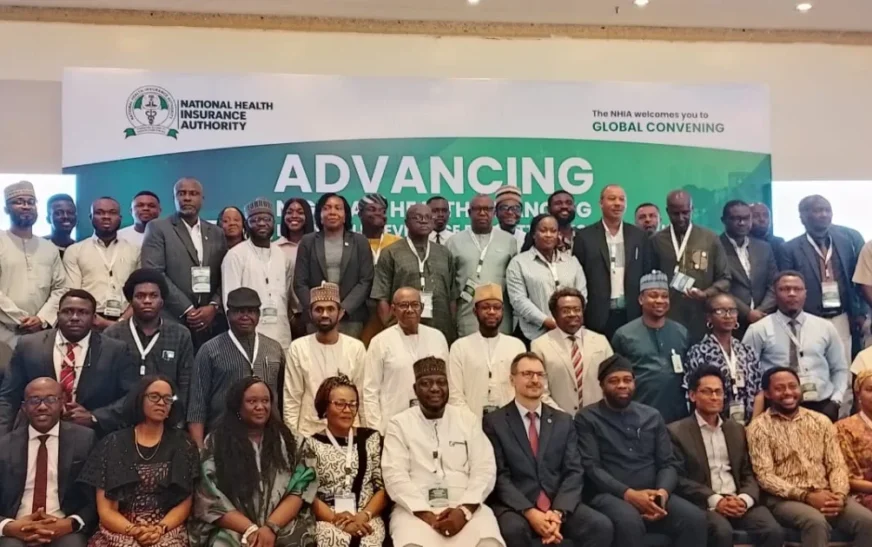
The Director-General of the NHIA, Dr Kelechi Ohiri, made the call on Monday in Abuja at the inaugural Nigeria Health Financing Research and Learning Forum, themed, “Evidence and Learning for Nigeria’s Health Financing Future: Building a Locally Led Research and Learning Ecosystem.”
Ohiri said Nigeria needed to take greater ownership of the research that informed its health financing policies and reforms, arguing that reliance on episodic studies had limited the country’s ability to build a sustained evidence base.
“For too long, our health financing initiatives in Nigeria have been shaped by well-meant studies designed, commissioned, analysed, reported, synthesised and presented to us at the finish line.
“While these studies have provided valuable insights, we have come to understand that episodic research can’t build the enduring policy foundation that is needed in Nigeria to sustain and inform long-term reforms and policies,” he said.
According to him, research sovereignty did not mean cutting Nigeria off from international partners, but ensuring that the country determined its priorities and used research directly to improve implementation.
“Research sovereignty doesn’t mean isolating ourselves from support and partners globally, but rather it means putting Nigeria in the driver’s seat in terms of defining our own questions, pushing to commission our own research, embedding learning directly into implementation, so that context-relevant outputs and outcomes guide policies and implementation,” Ohiri said.
He said international partnerships remained important but should focus on strengthening domestic capacity and supporting priorities identified by Nigeria.
Ohiri said the two-day forum would review five NHIA-commissioned studies on embedded learning and examine health financing experiences from Ethiopia, Ghana and India.
“This forum is not an academic exercise. It’s not held in isolation. It doesn’t cater to just the researchers, but it’s also one that policymakers can benefit from,” he said.
He identified mandatory health insurance coverage, equity, quality of care and sustainability as key areas of the NHIA’s health financing research agenda.
Ohiri said the authority had identified 15 studies linked to its strategic priorities and was working with national research institutions, universities and other stakeholders to establish a stronger health financing research ecosystem.
He said the country’s health insurance system remained fragmented, with 37 government health insurance schemes and more than 95 private health insurance companies.
“That has resulted in a lot of fragmented things that question sustainability. And so one of the areas of our research focus is really how do we enhance the sustainability of health insurance and financial protection,” he said.
Ohiri also announced plans for a national health financing observatory, a national research agenda for health financing, 15 research action plans and regional collaboration frameworks.
He said evidence was needed to support reforms aimed at expanding coverage, improving quality of care and strengthening financial protection.
“Evidence must serve reform,” Ohiri said, adding that research should help transform health financing into an economic infrastructure capable of protecting Nigerian households.
In a goodwill message, the World Health Organisation Representative in Nigeria, Dr Pavel Ursu, described health financing as foundational to universal health coverage and said implementation research was necessary to answer questions arising from health sector reforms.
He commended the establishment of the forum, saying it created an opportunity for Nigeria to translate global commitments on health financing and universal health coverage into concrete country-level action.
“The establishment of the Nigeria Health Financing Research and Learning Forum platform is really a great institutional opportunity, which will help us to a great extent with really unpacking the research questions and increasingly drive Nigeria’s own policy and implementation steps,” Ursu said.
Representing the Nigerian Institute of Social and Economic Research, Dr Yetunde Aluko said Nigeria needed locally generated evidence to guide health financing reforms.
She said research should become part of a continuous national learning system involving policymakers, researchers, implementers, communities and practitioners.
“For too long, research in many development sectors has been developed outside of Nigeria and is funded by short-term grants,” Aluko said.
“While partnerships with development partners remain very valuable, Nigeria needs an enduring national system in which policymakers, all stakeholders, researchers, implementers, communities and practitioners will jointly identify the questions that matter most, then generate the evidence and learn from implementation continuously, and then continuously adapt the policy.”
Aluko said health financing research should go beyond the production of reports and academic publications to establish what works, who benefits, under what circumstances and at what cost, while taking equity and sustainability into account.
Also speaking on behalf of development partners, GIZ Cluster Manager and Head of Programme, Fatima Zannah, said locally generated evidence was essential to developing health financing approaches that reflected the realities of Nigerians.
She said factors such as culture, religion, geography, income, education, gender and social networks influenced how people sought healthcare and should therefore be considered in health financing decisions.
“These realities shape the choices that people make about their care. We need to better understand how Nigerians find, where and how they seek care, and what influences barriers to the decisions that they are making,” Zannah said.
She urged stakeholders to use evidence to improve decision-making, transparency, equity and accountability in the health system, while also learning from countries facing similar challenges.
The Executive Director of the WHO Alliance for Health Policy and Systems Research, Dr Kumanan Rasanathan, said research and learning should be regarded as essential components of health systems rather than luxuries.
“Research cannot be a luxury. Learning cannot be a luxury. It is the foundation for health systems. If you don’t have your own knowledge, if you don’t know your own problems, if that is not preserved for future generations, you cannot be sovereign,” Rasanathan said.
He expressed concern about the dependence of many research institutions in developing countries on external funding, saying declining development assistance could weaken domestic knowledge systems.
Rasanathan called for stronger domestic institutions capable of generating and preserving knowledge, while remaining connected to national policy processes and able to provide independent advice.
He said Nigeria’s emerging research ecosystem should move towards nationally and sub-nationally determined research priorities and sustained learning institutions.
“If you don’t have your own research and learning system, you don’t have a map. And if someone else owns the map, you’re certainly not in charge of your journey,” he said.
All rights reserved. This material, and other digital content on this website, may not be reproduced, published, broadcast, rewritten or redistributed in whole or in part without prior express written permission from PUNCH.
Contact: [email protected]
Stay informed and ahead of the curve! Follow The Punch Newspaper on WhatsApp for real-time updates, breaking news, and exclusive content. Don’t miss a headline – join now!
Stay in the know—fast. Get instant alerts, breaking headlines, and exclusive stories with the Punch News App. Download now and never miss a beat.
Source: Punch Newspapers – Latest News